The Safety Lifeline Of Heavy Lifting Operations!
The safety lifeline of heavy lifting operations!
In scenarios such as wind turbine installation, bridge erection, and chemical equipment relocation involving heavy lifting, the stable operation of crawler cranes and truck cranes directly determines the project progress and personnel safety. The hook assembly, as the core device that bears the heavy load, relies on the precise cooperation of the ear hinge "force transmission hub", the hook head "load-bearing key", and the pulley "efficiency-saving core" - these four components together form the "safety loop" of the lifting equipment, which is crucial for withstanding extreme loads and preventing lifting accidents. Many engineering purchasers and lifting teams often wonder: Which parameters of the high-quality hook assembly should be considered for the ear hinge and hook head? How to match the pulley selection with the lifting conditions? This article dissects the key procurement aspects of the core components of crawler cranes and truck cranes from three dimensions: component function, process requirements, and selection guidelines.
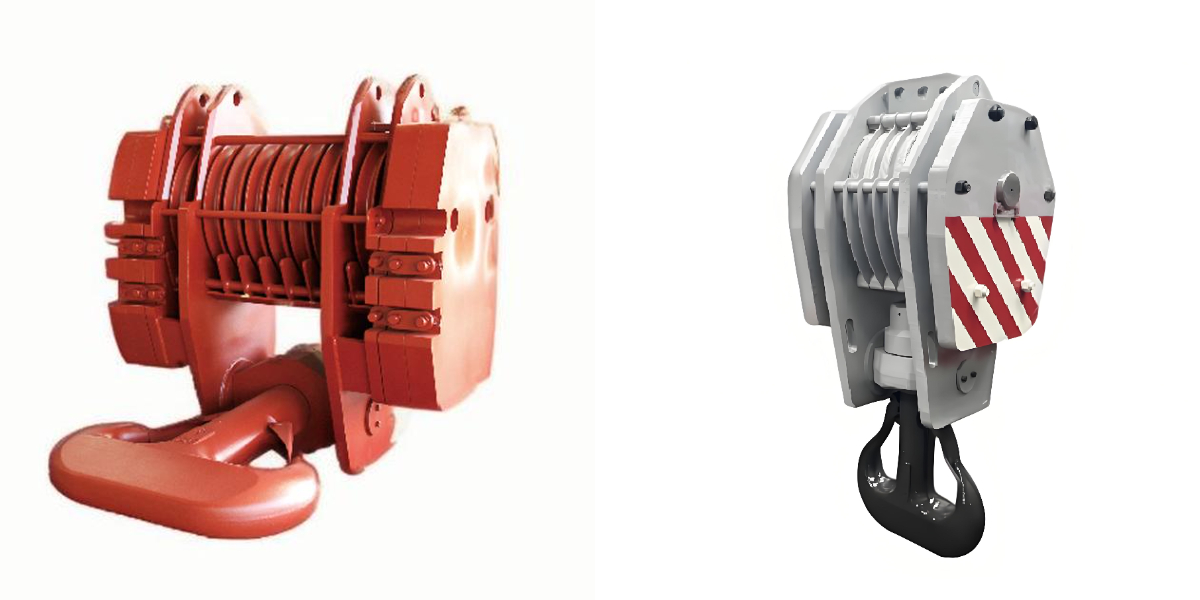
I. Four core components: The "lifting golden combination" of crawler cranes and truck cranes
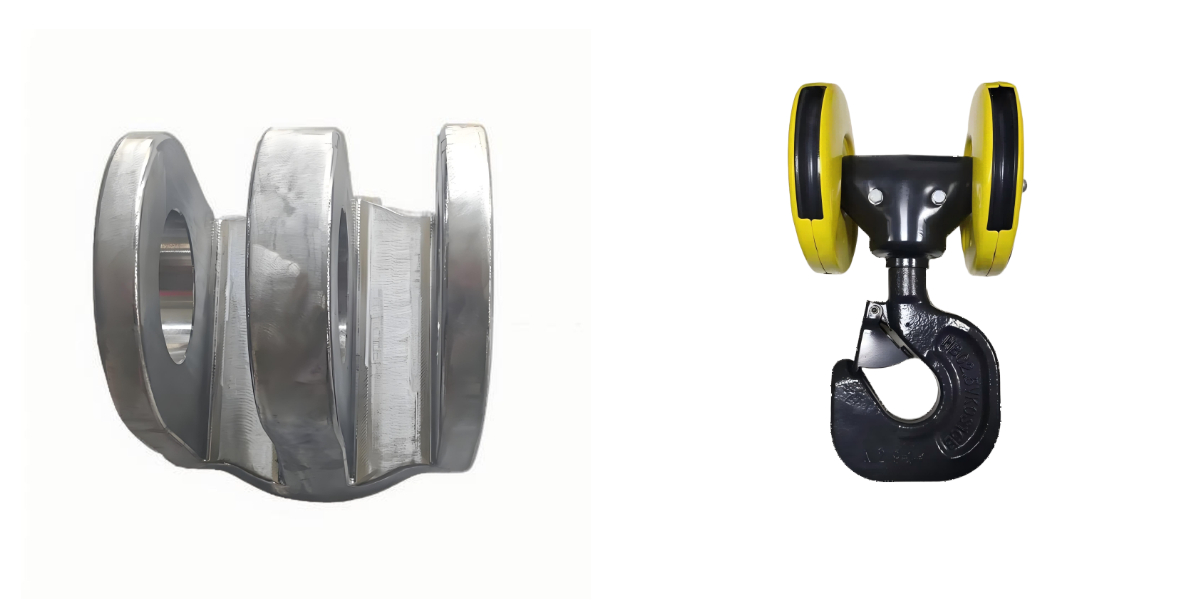
1. Hook assembly: The "load-bearing main body" of heavy lifting operations
The hook assembly is the core device that integrates the ear hinge, hook head, and pulley, directly bearing the full weight of the lifted load. Its structural design and material selection determine the upper limit of lifting safety:
It is made of high-strength alloy steel (20CrMnTi, 35CrMo) through integral forging, with a density of 99.9% and tensile strength of ≥1200 MPa, yield strength of ≥950 MPa, capable of easily meeting the heavy load requirements of crawler cranes of 500 ton class and truck cranes of 200 ton class;
It integrates anti-detachment devices (such as locking devices, safety pins), with flexible opening and closing and reliable vibration resistance, avoiding the detachment of heavy objects during lifting, in line with the GB 10051 "Lifting Hook" standard;
It is divided into single-hook assembly and double-hook assembly according to the lifting scenario: crawler cranes are mostly equipped with double-hook assemblies, with more uniform force distribution, suitable for ultra-long heavy objects such as wind turbine blades; truck cranes mainly use single-hook assemblies, with a compact structure, suitable for flexible transfer lifting needs.
2. Ear hinge: The "force transmission hub" of the hook assembly
The ear hinge is the key component connecting the hook assembly and the boom, responsible for transmitting all the loads during lifting, allowing the hook to rotate flexibly. Its stability directly affects the transmission efficiency:
It is integrated through one-piece forging, without welding weak points, with shear strength ≥800 MPa, impact toughness (-20℃) ≥60J/cm², capable of withstanding instantaneous impact loads during lifting start and braking;
The inner hole is matched with self-lubricating bearings, the surface is treated with nitriding, hardness reaches HRC55-60, friction coefficient ≤0.08, allowing flexible rotation without jamming, ensuring the hook can freely adjust the angle under heavy load;
The ear hinges of crawler cranes focus on torsional resistance (suitable for complex terrain lifting angles), while those of truck cranes focus on lightweight (meeting the flexibility requirements for transfer), both need to undergo non-destructive testing (UT/MT) to ensure there are no cracks inside.
3. Hook head: The "load-bearing key" of the hook assembly
The hook head is the component that directly contacts the heavy object, needing to withstand concentrated loads and friction wear, being the "wear-prone core" of the hook assembly, its process details determine the service life:
The hook head adopts die forging + surface quenching process, the curvature of the hook cavity is optimized for design, avoiding stress concentration when the heavy object is suspended, the breaking load is more than 3.5 times the rated load (in line with safety factor requirements);
The surface hardness reaches HRC58-62, the wear resistance is 2.5 times that of ordinary processed parts, when the wear of the hook head exceeds the nominal size by 10%, it needs to be forcibly replaced to avoid overload breakage;
It is optimized for different working conditions: hook heads for wind turbine lifting are equipped with anti-slip blocks to prevent the heavy object from shifting due to wind load; hook heads for chemical lifting are treated with anti-corrosion (galvanizing + passivation), with salt spray corrosion resistance of more than 1000 hours.
4. Pulley: The "efficiency-saving core" of lifting operations The pulley achieves force decomposition through the winding of the rope, reducing the traction force required for hoisting. Its accuracy and wear resistance directly affect the efficiency and safety of hoisting:
The pulley body is made of aluminum alloy or alloy steel forgings, and after precise processing, the surface roughness Ra is ≤ 1.6 μm. The rope groove curve fits perfectly with the steel wire rope, reducing the wear of the steel wire rope and extending the service life of the rope;
The bearings use deep groove ball bearings or self-aligning roller bearings, with a sealed dust-proof structure. They can still rotate stably in dusty and humid environments, with a maximum rotational speed of ≥ 300 r/min;
The number of pulleys is matched according to the hoisting tonnage: for heavy-duty scenarios of crawler cranes, 4-6 sets of pulley groups are used, achieving significant force-saving effects; for light and medium-duty cranes, 2-3 sets of pulley groups are used, balancing efficiency and structural compactness.
II. Crawler Crane vs. Truck Crane: Differences in Core Component Operating Conditions
Due to different working scenarios and equipment characteristics, there are clear differences in the design and selection of the four core components of crawler cranes and truck cranes:
| Component | Crawler Crane Adaptation Features | Truck Crane Adaptation Features |
| Hook Assembly | Double-hook mainly, rated load 50-1200 tons, focusing on torsion resistance | Single-hook mainly, rated load 20-200 tons, focusing on lightweight design |
| Ear Hinge | Large-diameter design, higher shear strength, suitable for complex terrain lifting | Compact structure, low rotation resistance, suitable for frequent transfer |
| Hook Head | Deep hook cavity, more robust anti-slip device, suitable for ultra-long heavy objects | Small-sized hook head, convenient opening and closing, suitable for flexible lifting |
| Pulley | Multi-pulley block (4-6 units), high force-saving ratio | Few-pulley block (2-3 units), simple structure and easy maintenance |
III. Core Component Selection Guide: 3 Key Points to Avoid Purchase Mistakes
1. Verify Materials and Process Reports
Priority choose products with forging processes, requiring suppliers to provide material test reports, non-destructive testing reports (ultrasonic testing UT, magnetic particle testing MT), ensuring that the pins, hooks have no cracks, inclusions, etc., with a qualification rate of ≥ 99.8%;
Confirm that the product complies with industry standards: the hook assembly must comply with GB 10051, the pulley must comply with GB/T 10055, the pins must pass tensile and shear strength tests.
2. Match Working Conditions and Equipment Parameters
Select according to the hoisting tonnage: for truck cranes below 50 tons, select the rated load 100-ton-level hook assembly, for crawler cranes above 100 tons, select double-hook assemblies of 200 tons or above, with a safety factor of ≥ 3.5;
Adapt to extreme working conditions: for high-temperature environments (such as steel plant hoisting), select heat-resistant alloy steel components, for coastal salt spray environments, select stainless steel or anti-corrosion treatment components, for wind power high-altitude hoisting, select hoist assemblies with anti-vibration and anti-loosening design.
3. Focus on Manufacturer Qualifications and Cases
Prioritize choosing suppliers with a complete industrial chain (smelting - forging - heat treatment - precision processing), ensuring material consistency;
Pay attention to whether the manufacturer has cooperation cases with well-known crane equipment enterprises such as XCMG, Sany, and Zongli, whether the product has been verified for 1000 hours or more of heavy-load working conditions, and confirm the response capability for after-sales services (such as spare parts supply, maintenance guidance).
IV. Industry Trends: Upgrade of Core Components to "High Precision and High Technology"
With the development of hoisting equipment towards larger sizes and intelligence, the four core components present three upgrade trends:
Material Upgrade: Use ultra-high-strength alloy steel (such as 40CrNiMoA), achieving component weight reduction of 15%-20% while ensuring strength, improving the hoisting efficiency of the equipment;
Intelligent Transformation: Integrate weight sensors and angle sensors in the hook assembly, real-time monitoring of hoisting load and posture, automatic alarm in case of exceeding limits, reducing operational risks;
Precision Processing: Optimize the force-bearing structure of the pins and the rope groove curve of the pulley through digital twin technology, with dimensional accuracy up to IT8 grade, reducing component wear and extending service life.
Summary
The hook assemblies of crawler cranes and truck cranes "affect the whole system with a single move", and their performance core lies in the force transmission stability of the pins, the reliability of the hook head's bearing capacity, and the efficiency and economy of the pulleys. In the current era of increasing heavy-load hoisting demands, choosing core components that are adapted to working conditions and of high quality is the key to safe and efficient project advancement.
If you need to further understand the core component adaptation schemes, material performance comparison tables for different tonnage crawler cranes/truck cranes, or maintenance and operation guidelines for the hook assemblies, please feel free to contact us at any time! We will provide you with high-quality products that meet industry standards and professional technical support.