How to Solve Cracking and Leakage of Nuclear Grade Valve Forgings? Forging, Heat Treatment & Precision Machining Improve the Service Life & Safety of Nuclear Power Equipment
Nuclear power falls under the special energy sector with ultra-high safety requirements. Reactors, cooling loops and pipeline isolation systems operate persistently under harsh conditions of high temperature, high pressure, intense radiation and corrosive media. As the barrier for pipeline switching, nuclear grade valve forgings are critical pressure-bearing components that guarantee stable operation of nuclear power units. Meanwhile, heavy-duty construction machinery supporting large-scale nuclear power construction and maintenance relies heavily on matched hydraulic valves and pressure-bearing forgings. Both application scenarios impose extremely stringent requirements on forging raw materials, processing techniques and heat treatment standards.
Conventional carbon steel forgings suffer from drawbacks such as coarse grain structure, internal porosity, poor corrosion resistance and insufficient strength, making them ineligible for nuclear power applications. Qualified manufacturers must adopt three core procedures — forging shaping, heat treatment performance modification and CNC precision machining — to produce nuclear grade valve forgings that comply with nuclear safety standards. Below is a full breakdown of the complete production process and industry applications.
I. Two Major Application Scenarios: Main Nuclear Power Equipment & Forgings for Nuclear Construction Machinery
1. Core Demand: Dedicated Nuclear Grade Valve Forgings for Nuclear Power
Valve bodies, bonnets, flanges and cylindrical forgings for Class 1, 2 and 3 nuclear loop valves are collectively defined as nuclear grade valve forgings. They are continuously exposed to radiation environments with high-temperature and high-pressure cooling water and borated water as working media.
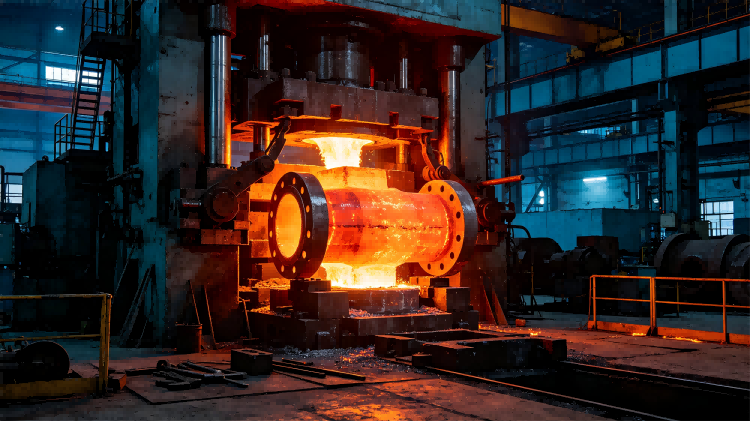
1. Forging as the foundational process: Vacuum electroslag remelting steel ingots are adopted for integral open-die or closed-die forging. The process breaks down coarse as-cast grains and forms continuous metal flow lines wrapping the pressure-bearing cross-sections, eliminating internal defects including pores, porosity and delamination, so as to fundamentally prevent cracking and leakage under high pressure.
2. Heat treatment for performance optimization: Dedicated heat treatment production lines are equipped after forging, covering multiple processes such as normalizing, quenching & tempering, tempering and stress-relief annealing. These processes precisely control hardness, impact toughness and radiation resistance of forgings, relieve residual forging stress and avoid deformation during long-term service.
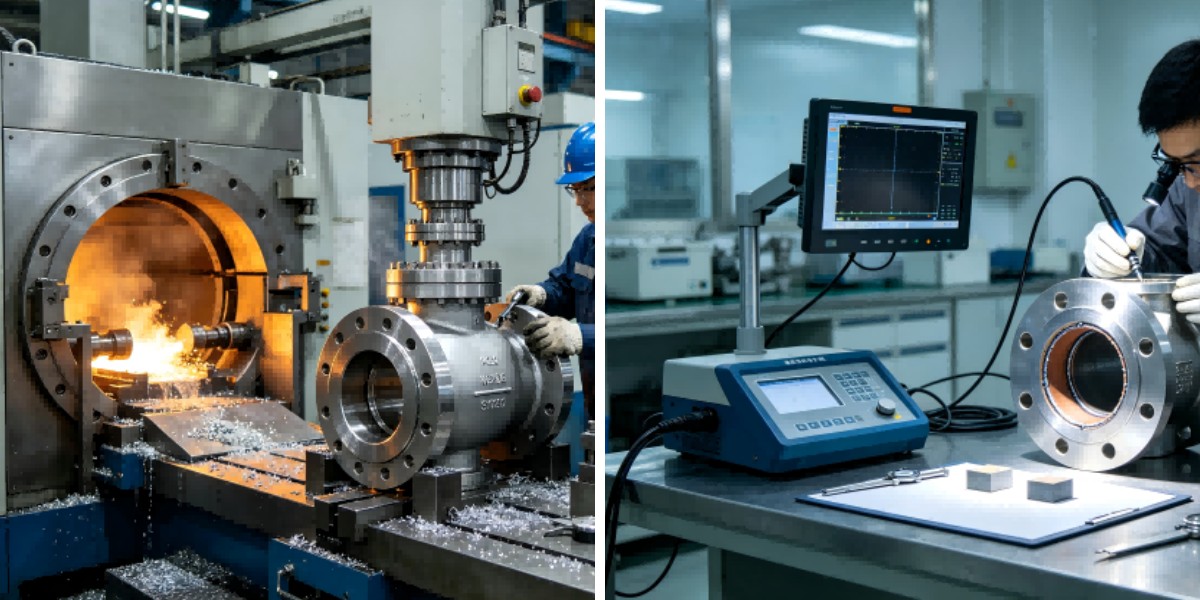
3. Precision machining for sealing forming: Five-axis CNC precision machining is carried out post heat treatment to fabricate sealing surfaces and flange connection dimensions with high accuracy. Flatness and surface roughness meet nuclear equipment sealing standards to eliminate medium leakage, satisfying the long-term operation demands of million-kilowatt nuclear power units.
2. Supporting Scenario: Heavy-Duty Construction Machinery Forgings for Nuclear Power Construction
Construction machinery used in nuclear plant infrastructure, equipment hoisting and maintenance (including crawler cranes, hydraulic drill rigs, special transport vehicles and hydraulic pump stations) adopts the same integrated forging, heat treatment and precision machining process for hydraulic control valve forgings, high-pressure pipe connectors and load-bearing valve body forgings. Though free from nuclear radiation exposure, these construction machinery forgings endure long-term heavy load impacts and hydraulic high pressure. Mature forging technology enhances structural strength, heat treatment eliminates processing stress, and precision machining ensures hydraulic sealing accuracy, adapting to harsh construction site conditions and reducing equipment downtime caused by failures.
II. Three Defining Processes: Forging, Heat Treatment and Precision Machining Determine the Safety Grade of Nuclear Grade Valve Forgings
1. Forging: The Fundamental Framework of Forging Performance
Direct machining of castings is prohibited for nuclear grade forgings; integral forging is mandatory:
· High-temperature forging compacts the internal metal structure and eliminates casting defects of steel ingots;
· A properly designed forging ratio ensures intact metal flow lines at valve wall thicknesses and corners, delivering far superior pressure resistance and fatigue resistance compared with castings;
· Customized forging temperature ranges are formulated for special nuclear-grade materials (austenitic stainless steel, chromium-molybdenum heat-resistant alloy steel) to prevent embrittlement of forgings.
2. Heat Treatment: Unlock Core Properties of Forgings Including Heat Resistance, Radiation Resistance and Corrosion Resistance
As-forged blanks feature uneven hardness and massive residual stress, which renders them unfit for nuclear power service without heat treatment:
1. Stress-relief annealing: Eliminates residual stress generated during forging to avoid deformation and cracking after precision machining;
2. Quenching & tempering: Balances strength and toughness of forgings to resist brittle fracture under high-temperature working conditions;
3. Stabilization treatment: Applied to stainless steel nuclear grade valve forgings to improve intergranular corrosion resistance against corrosive media in nuclear power systems. Heat treatment test specimens are retained for each batch of forgings, and complete heat treatment curve reports are issued to meet audit standards of domestic and overseas nuclear power projects.
3. Precision Machining: Guarantee Sealing Accuracy and Assembly Tolerances
Blanks suffer large dimensional deviations after heat treatment, so CNC precision machining serves as the final procedure to achieve reliable valve sealing:
· High-precision turn-milling composite machining of valve flow channels, flanges and sealing bevels;
· Precision lapping of sealing surfaces to achieve zero leakage under both high and low pressure conditions;
· Strict tolerance control for rapid assembly with standardized nuclear power pipelines and hydraulic systems of construction machinery.
III. Core Differences Between Nuclear Power Forgings and Ordinary Industrial Forgings
1. Stricter Non-Destructive Testing Standards: 100% ultrasonic and magnetic particle non-destructive testing is implemented for nuclear grade valve forgings, with any tiny defects leading to scrapping. Sampling inspection standards for construction machinery matching forgings are also higher than those for general mechanical parts.
2. Fully Traceable Processes: All records including forging heating cycles, heat treatment temperature curves and precision machining procedures are filed, with complete material certificates available upon request.
3. Custom Specialized Materials: Heat-resistant and radiation-resistant stainless steel and alloy steel exclusive for nuclear power; general alloy steel such as 42CrMo is adopted for ordinary construction machinery forgings.
4. Extended Service Life Guarantee: Nuclear power projects are designed for a service life of 60 years, and the fatigue resistance and aging resistance of forgings far outperform conventional construction machinery components.
IV. Product Supply Scope
1. Main Nuclear Power Equipment: Class 1 / 2 / 3 nuclear grade valve forgings, valve bodies, bonnets and pipe nozzle forgings;
2. Supporting Parts for Nuclear Construction Machinery: Hydraulic valve forgings, high-pressure connectors, load-bearing flanges and hydraulic valve body forgings for construction machinery;
3. Export Supporting Service: Bulk order supply for domestic and overseas nuclear power projects and engineering equipment manufacturers. Sandblasting anti-rust treatment, export wooden case packaging and full-container sea shipment are available. Complete test documents including NDT inspection reports, heat treatment records and material spectrum analysis certificates can be provided.
V. Conclusion
If you are seeking a reliable source manufacturer of nuclear power forgings to customize nuclear grade valve forgings compliant with nuclear power standards, or purchase pressure-bearing forgings supporting nuclear construction machinery, we provide one-stop processing services covering forging, professional heat treatment and high-precision CNC precision machining.
Please send your product drawings, working conditions, annual purchasing volume, acceptance standards and other requirements. We offer free sample trial production, technical process proposals and accurate quotations. Factory site visits are welcome, and we deliver one-stop solutions to resolve procurement challenges for special nuclear power forgings.
- Previous : Are weld leaks and structural cracking frequent? High-quality welded parts extend the service life of transformer oil tank shells and construction machinery
- Next : Why Choose Precision Forgings for SMR Small Modular Reactors? Technical Analysis of Nuclear Main Pump Pump Casings & Impeller Blanks