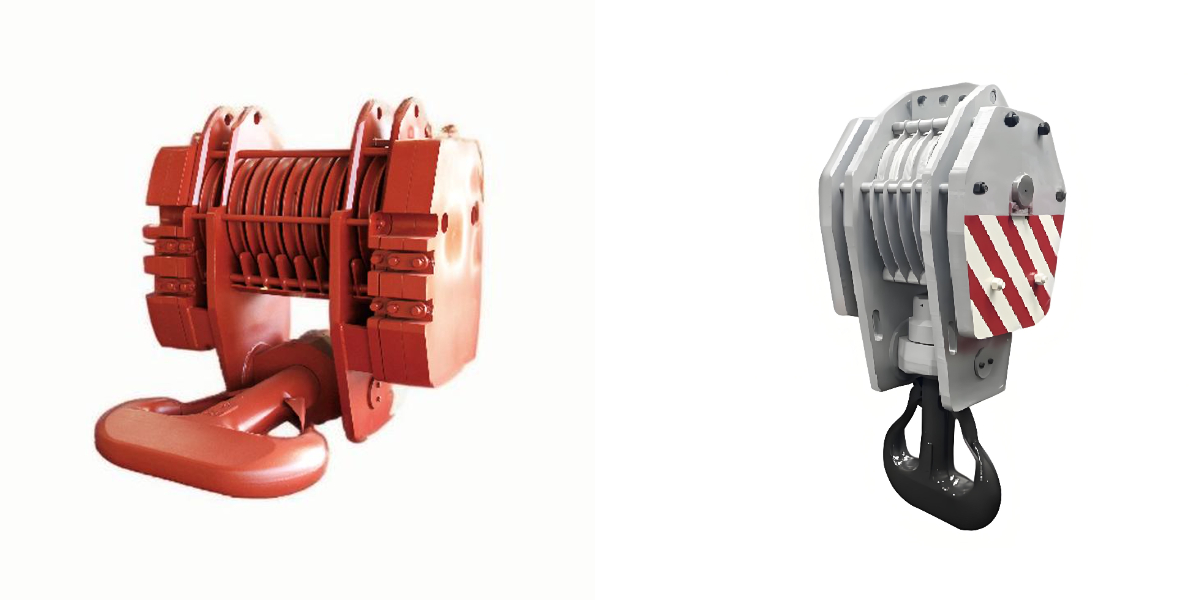
Difference Between Hook Block and Hook Assembly: Analysis of the Differences in the Core Components of Crane Hook
Difference Between Hook Block and Hook Assembly: Analysis of the Differences in the Core Components of Crane Hook
In the lifting system of the crane, the crane hook is the core component that directly bears the heavy object, while the crane hook assembly and the hook block, as the key supporting components around the hook, jointly determine the safety and efficiency of the lifting operation. The two are often confused, but there are significant differences in structural composition, functional positioning, and manufacturing process, and both rely on forging process to ensure core performance. This article will comprehensively dissect the differences between the hook pulley block and the hook assembly, and combine the enabling value of forging technology to help accurately understand the core logic of the related components of the crane hook.
I. Core Definition: Clarify the essential differences between the two components
1. Crane Hook Assembly: The "complete functional unit" of the hook
Crane hook assembly is an integrated component built around crane hook and is a complete functional module directly used for hanging heavy loads in the crane lifting system.
Its core composition includes three major types of components:
Core load-bearing component: The crane hook (single hook or double hook) made by forging process is the force-bearing core of the entire assembly.
Auxiliary force transmission components: hook tail frame, thrust bearing, pin shaft, etc., are used to fix the hook, distribute the load and reduce rotational friction.
Safety protection parts: anti-disengagement devices (such as locking devices, anti-jump rope baffles), buffer pads, etc., to prevent heavy objects from falling off and enhance the safety of operations.
In simple terms, crane hook assembly is a complete combination of "hook + accessory", which can be directly installed on the hoisting mechanism of the crane and has the complete functions of independent load-bearing and hanging heavy objects.
2. Hook Block: The "power-saving transmission unit" of the lifting system
The hook pulley block is the core component in the crane hoisting mechanism responsible for the conversion of force and speed. Essentially, it is a combination of "pulley + pulley frame + connection structure". In some scenarios, it is used in conjunction with the hook assembly, but its functional focus is completely different.
Its core components include:
Pulley assembly: Multiple pulleys (the number is designed according to the lifting ratio), achieving "effort-saving" or "speed increase" through the winding of steel wire ropes;
Load-bearing frame: A metal frame (mostly forged or welded) used to fix the pulley, which needs to withstand the tensile force of the steel wire rope and the indirect load of the heavy object.
Connection interface: Components such as pins and lifting lugs that are connected to the hook assembly or lifting mechanism, ensuring the stability of power transmission.
The core function of the Hook pulley block is to reduce the load of the lifting motor through the ratio design of the pulley block to achieve smooth lifting of heavy loads. It does not come into direct contact with the heavy object itself and needs to be combined with the Crane Hook Assembly to complete the hanging operation.
Ii. Core Differences Comparison: Clearly Distinguished from Five Dimensions
Comparison dimension crane hook assembly and hook block
The core functions include directly mounting heavy objects, carrying loads, ensuring safe mounting, transmitting power, changing the direction of force, and achieving effortless lifting
Core components: forging crane hook (hook body), anti-disengagement device, hook tail frame pulley, pulley frame, pin shaft, bearing
The force application mode directly bears the vertical and impact loads of heavy objects, as well as the tensile force of the steel wire rope and the radial load of the pulley
The manufacturing core relies on the Forging process to create a high-strength hook body, ensuring load-bearing capacity. The pulley frame can be forged or welded, and the pulley emphasizes wear resistance and rotational flexibility
The application association can be used independently (for small cranes) or in conjunction with the Hook pulley block. It must be used in conjunction with the Crane Hook Assembly and cannot complete the lifting operation independently
Iii. Forging process: The core performance guarantee of the two major components
Whether it is the core component of the crane hook assembly or the key structure of the hook pulley block, the forging process is the core means to achieve high performance and high reliability, especially for heavy-load crane scenarios:
The core role of forging in crane hook assembly
The crane hook, as the force-bearing core of the hook assembly, must ensure its performance through forging processes:
Material optimization: High-strength alloy steels such as 42CrMo and 35CrNiMo are selected. Through forging to refine grains and eliminate defects like pores, the tensile strength can reach over 800MPa, capable of withstanding heavy loads and impacts.
Structural integrity: The hook body is integrally forged without any welding seams, avoiding the risk of fracture caused by stress concentration and being suitable for the crane's design life of over 20 years.
Precision control: The hook shape, hook neck and other key structures of the hook are precisely formed through die forging process. Subsequently, they are finely processed to ensure the fit accuracy with the hook tail frame and pin shaft, reducing operational wear.
In addition, key load-bearing components such as the hook tail frame and lifting lugs in the hook assembly are often manufactured by forging process to ensure the balanced force distribution and structural stability of the entire assembly.
2. The application value of forging in hook pulley blocks
The pulley frame of the hook pulley block serves as the core load-bearing structure, and the forging process can significantly enhance its performance:
Heavy-load adaptation: The pulley frames of large cranes need to bear indirect loads of hundreds of tons. Forging processes can enhance their strength and toughness, preventing deformation or fracture.
Wear resistance and fatigue resistance: After forging, the pulley frame undergoes heat treatment, enhancing its surface hardness and fatigue resistance, enabling it to withstand long-term alternating loads and the friction of steel wire ropes.
Structural adaptation: Complex-structured pulley frames (such as multi-pulley integrated frames) can be integrally formed through die forging, reducing assembly steps and enhancing overall stability.
Iv. Typical Application Scenarios: Component Selection and Process Adaptation
1. Application scenarios of Crane Hook Assembly
Small cranes (such as electric hoists and small truck cranes) : They adopt independent hook assemblies. The hooks are forged and directly installed on the lifting mechanism, suitable for light-load and low-frequency lifting operations.
Medium and large cranes (such as crawler cranes and port cranes) : The hook assembly is used in conjunction with the hook pulley block. The forged hook bears heavy loads, and the anti-disengagement device and buffer structure ensure the safety of operations in complex scenarios such as ports and construction sites.
Special scenarios (such as offshore wind power and metallurgical hoisting) : It adopts a double-hook forged hook assembly, combined with a corrosion-resistant coating, suitable for heavy-load hoisting in harsh environments.
2. Application scenarios of hook pulley blocks
High-rate lifting scenarios (such as bridge hoisting and equipment handling) : Through a pulley block composed of a forged frame with multiple pulleys, heavy-load labor-saving lifting is achieved, reducing the motor load.
High-speed lifting scenarios (such as container cranes) : Lightweight forged pulley frames combined with high-precision pulleys enhance lifting speed and efficiency, making them suitable for high-frequency operations.
Special working conditions (such as mining and chemical industries) : The pulley frame is forged and treated with anti-corrosion, and the pulleys are made of wear-resistant materials, which are suitable for stable operation in dusty and corrosive environments.
V. Selection and Maintenance: Focus on the safety criticality of core components
1. Key points for selection
Give priority to confirming the forging quality: When choosing crane hook assembly, it is necessary to verify the forging process report and material certificate of the hook body to ensure that it is an integral forged part; For hook pulley blocks, attention should be paid to the manufacturing process of the pulley frame. In heavy-load scenarios, forged pulley frames are preferred.
Matching working condition requirements: For light-load and small cranes, simple hook assemblies can be selected. For heavy-load and high-frequency operations, forged hook assemblies and multiple pulley blocks are required to enhance lifting efficiency and safety.
Verify safety certification: Ensure that crane hook assembly is equipped with safety configurations such as anti-disengagement devices and load limiters, and the product has passed industry standard certification.
2. Key matters for daily maintenance
Regularly inspect the forged components: Focus on checking the stress concentration areas such as the hook neck and hook tip of the crane hook, as well as the forged connection points of the pulley frame, to see if there are cracks, wear or deformation. Stop using it immediately if any problems are found.
Ensure lubrication and protection: Regularly apply lubricating oil to the bearings and pins of the hook assembly, as well as the pulley bearings of the pulley block, to prevent dry friction. Anti-rust treatment should be carried out on forged components, especially in outdoor or corrosive environments.
Regular non-destructive testing: For the hooks and forged pulley frames of heavy-duty cranes, ultrasonic or magnetic particle testing should be conducted every 1-2 years to identify internal fatigue cracks and prevent the accumulation of potential hazards.
Vi. Industry Development Trends: Component Integration and Forging Technology Upgrade
With the development of cranes towards larger, smarter and lighter sizes, two major components are showing a clear upgrading trend:
Integrated design
The crane hook assembly and the hook pulley block have gradually achieved integrated integration. Through the forging process, an integrated structure of "hook - pulley frame" is created to reduce assembly links and improve the force balance and overall efficiency.
2. Digitalization of forging processes
Introduce digital twins and intelligent forging equipment to achieve full-process control over the forging of components such as hooks and pulley frames, precisely controlling parameters like heating temperature and forging pressure, and enhancing product consistency and performance stability.
3. Integration of new materials and new processes
By using new materials such as high-strength aluminum alloy and composite materials, combined with precision forging technology, the weight of components is reduced while ensuring strength, thereby lowering the energy consumption of the crane. Meanwhile, after forging, surface treatment technologies such as laser cladding are adopted to further enhance the wear resistance and corrosion resistance.
Summary
Although the crane hook assembly and the hook block both belong to the core components of the crane lifting system, their functional positioning is completely different: The former is a "complete functional unit" that directly hangs heavy loads, while the latter is a "transmission unit" that achieves effortless lifting. The two are often used in combination but cannot replace each other.
Forging process, as the core manufacturing method, provides high strength, high toughness and structural stability for key components of crane hook assembly such as the hook body, hook tail frame, and pulley frame of the hook pulley block, and is the core support for ensuring operation safety under heavy load and complex working conditions.
In the future, with the advancement of integrated design and digital forging technology, the two major components will further achieve performance upgrades and deeply collaborate with crane hook, injecting strong impetus into the efficient, safe and lightweight development of the crane industry, and continuously safeguarding the hoisting safety of global engineering construction and industrial production.