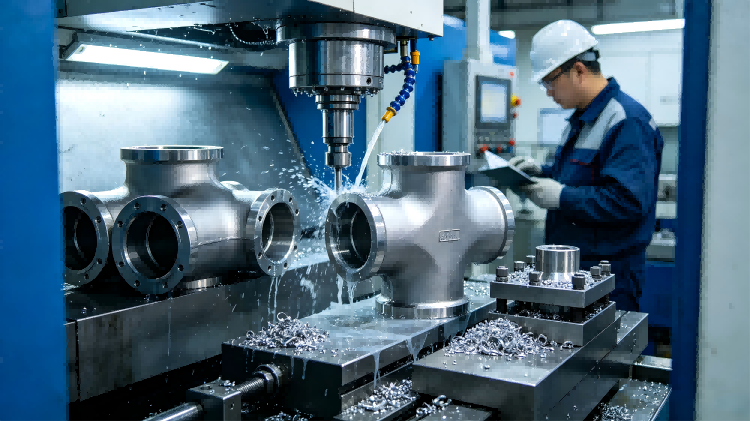
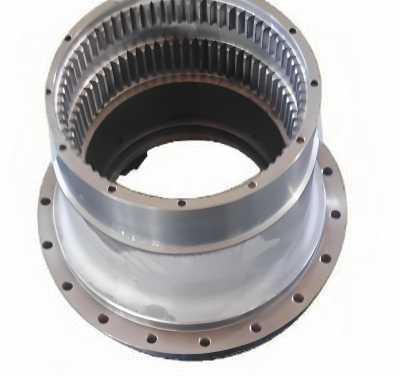
Nuclear-Grade Pipe Fittings Manufacturer: Custom Forged High-Pressure Flanges, Tees and Special-Shaped Pipe Fittings with Precision Machining
Nuclear-grade piping serves as the "vascular system" for primary loops, secondary loops and auxiliary heat exchange systems in nuclear power plants. It continuously operates under extreme conditions including high temperature, high pressure, heavy corrosion, trace radiation and alternating pressure shocks. Compared with piping used in conventional chemical and power industries, nuclear piping imposes extremely stringent mandatory requirements on sealing performance, structural compactness, fatigue resistance and material stability.
Over 90% of piping failures occur at connecting parts, flow diversion components and irregular transition sections, namely key fittings such as high-pressure flanges, tees and special-shaped pipe fittings. Ordinary castings, rolled and welded pipe fittings contain inherent defects including internal porosity, cavities, slag inclusions and weld imperfections. When running under long-term high pressure, they are prone to cracking and medium leakage, which disqualifies them from nuclear power applications.
For this reason, formal nuclear power projects uniformly adopt forging to produce blanks, followed by precision machining for final forming, eliminating potential risks from the source. This article elaborates on the forging advantages, precision machining standards and nuclear power application scenarios of high-pressure flanges, tees and special-shaped pipe fittings for nuclear-grade piping.
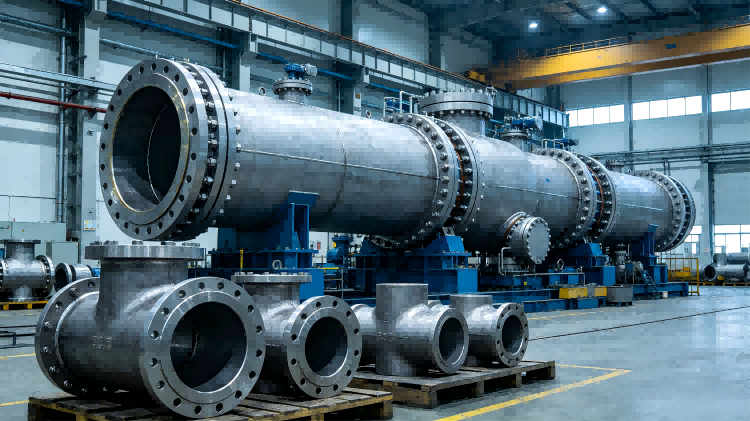
I. Why Must Nuclear-Grade Piping Adopt Forged Fittings?
Welded or cast ordinary pipe fittings are prohibited to replace forged fittings in nuclear piping, mainly for three core reasons:
· Extremely dense internal structure: High-temperature forging compacts metal grains and eliminates porosity, cavities and microcracks. Free of integral weld seams, forged fittings deliver far higher pressure bearing capacity than welded alternatives and satisfy nuclear-grade high-pressure working conditions.
· Enhanced fatigue and creep resistance: Forging generates continuous and uniform metal flow lines. The pipe fittings resist deformation and cracking under long-term alternating pressure and temperature fluctuations, matching the 60-year design service life of nuclear power facilities.
· Controllable precision for zero-leakage sealing: Forged blanks feature stable dimensions. Subsequent precision machining strictly controls end flatness, perpendicularity and bore tolerances to guarantee reliable sealing of high-pressure flanges and special-shaped pipe fittings.
II. Process Analysis of Three Core Forged Fittings for Nuclear-Grade Piping
1. Forged High-Pressure Flanges – Core Sealing Components for Piping
Nuclear-grade high-pressure flanges are critical pressure-bearing sealing parts for pipeline docking and equipment connection, responsible for sealing high-temperature & high-pressure media and facilitating equipment assembly and disassembly. Conventional plate-cut welded flanges suffer heavy internal stress and poor flatness, easily causing gasket extrusion and leakage under high pressure.
Forged high-pressure flanges are integrally formed via open-die or closed-die forging, featuring dense structure and uniform hardness. After stress-relief heat treatment, CNC precision machining is performed on sealing surfaces, bolt holes, end faces and shoulders to achieve flatness and roughness fully compliant with nuclear-grade sealing standards. Widely used for high-pressure connections of main nuclear piping, heat exchange pipelines and pressure vessel nozzles.
2. Forged Tees – Key Components for Flow Diversion & Convergence
Nuclear piping systems require frequent flow splitting, merging and branch switching. Forged tees are essential to maintain stable pipeline flow. Traditional stamped and welded tees suffer severe stress concentration at three-way intersections, vulnerable to perforation and cracking under long-term medium erosion.
Integrally forged tees are shaped in one piece with continuous metal flow lines and uniform wall thickness at intersections, free of weak welding zones. Precision machining optimizes flow channel geometry to ensure smooth medium circulation and even flow resistance. Effectively resisting high-pressure erosion and alternating loads to prevent local stress cracking, they are widely deployed in nuclear primary loops and auxiliary cooling water pipelines.
3. Forged Special-Shaped Pipe Fittings – Custom Parts for Transition, Reducer and Bend Applications
Nuclear power plants adopt complex piping layouts involving numerous non-standard structures such as reducers, irregular-angle bends, eccentric transitions and special-angle elbows, which cannot be met by standard pipe fittings, requiring customized special-shaped pipe fittings.
Custom forging technology is adopted to manufacture various special-shaped elbows, reducing pieces and eccentric transition fittings. Forged blanks have no joints or welds with consistent structural strength. Five-axis precision machining accurately modifies irregular curved surfaces, pipe diameter tolerances and connecting end faces, perfectly adapting to complex nuclear piping layout conditions. It solves industry pain points including difficult docking, poor sealing and high leakage risk for non-standard pipelines.
III. Dual Process Guarantee: Forging + Precision Machining to Meet Nuclear Safety Standards
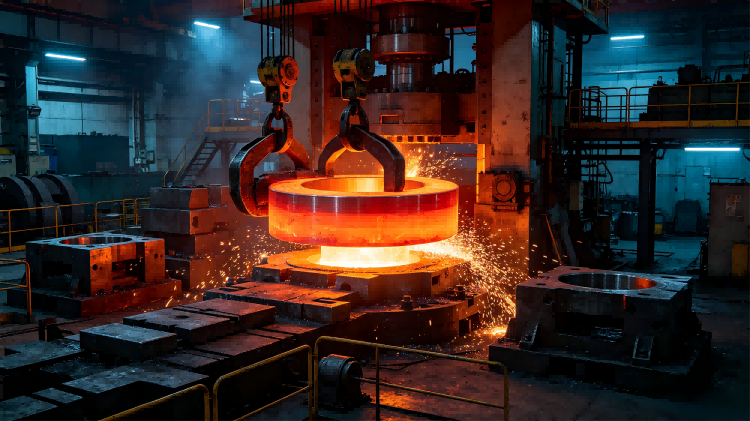
1. Forging Process: Establish Nuclear-Grade Structural Strength
Custom forging ratios and forging temperatures are formulated according to fitting structures to break coarse grains and compact internal structures. Consistent mechanical performance is guaranteed for high-pressure flanges, tees and special-shaped pipe fittings without weak cross-sections, preventing cracking and leakage risks starting from raw materials.
2. Heat Treatment: Stress Relief & Material Stabilization
All forged pipe fittings undergo stress-relief annealing and quenching & tempering to eliminate residual forging stress, stabilize metallographic structures, avoid deformation after precision machining and creep during operation, and meet long-term stable operation requirements of nuclear power units.
3. Precision Machining: Achieve Nuclear-Grade Sealing & Assembly Accuracy
After heat treatment, CNC turning-milling and precision grinding are applied to refine flange sealing surfaces, tee flow channels and irregular curved surfaces. Assembly tolerances, flatness and roughness are strictly controlled to ensure precise on-site installation, tight sealing and zero medium leakage.
IV. Core Differences Between Nuclear-Grade Forged Pipe Fittings and Ordinary Pipe Fittings
1. Higher Safety: Integrally forged without weld seams to avoid welding defects, suitable for nuclear high-pressure and radiation environments.
2. Higher Precision: Full-process precision machining, with dimensional tolerance and sealing standards exceeding conventional industrial pipe fittings.
3. Longer Service Life: Excellent resistance to fatigue, corrosion and creep, matching the ultra-long service cycle of nuclear power projects.
4. Full Traceability: Forging batches, heat treatment curves, NDT reports and material spectrum test records are all filed to satisfy audit requirements of nuclear power projects.
V. Supply Scope & Application Scenarios
Applicable scenarios: Class 1 / 2 / 3 piping systems of nuclear power plants, nuclear heat exchange equipment, nuclear facility maintenance & renovation, supporting new nuclear energy projects.
Main products: Nuclear-grade forged high-pressure flanges, forged tees and forged special-shaped pipe fittings. Mass production of standard parts and customization based on non-standard drawings are available, with full-size precision machining service. Export anti-rust packaging can be provided. Complete qualification documents including NDT non-destructive testing reports, material inspection certificates and heat treatment records are deliverable.
VI.Conclusion
If you are sourcing supporting fittings for nuclear-grade piping, and require customized forged high-pressure flanges, tees, special-shaped pipe fittings or seeking a professional manufacturer for high-precision machined nuclear pipe fittings, please send your drawings, working conditions, dimension standards and purchasing requirements. We provide free process proposals, accurate quotations and sample trial production. Factory visits are welcome. We deliver one-stop customized solutions for special forged fittings of nuclear power piping.