Ship forgings: The "safety cornerstone" of deep-sea navigation, these core components are all supported by it!
Ship forgings: The "safety cornerstone" of deep-sea navigation, these core components are all supported by it!
In the rough ocean, ships need to withstand extreme tests such as strong winds, huge waves, high-pressure corrosion and long-term vibration. Their safety and reliability completely rely on the quality of core components. Forgings, as the "synonym for strength and durability" in shipbuilding, have become core components of key parts such as the ship's power system, propulsion system, and hull structure, thanks to the outstanding performance endowed by precision forging technology. Many purchasers from shipbuilding enterprises are puzzled: On which core components are ship forgings specifically applied? Why must ships sailing in the deep sea use high-quality forgings? How to select forging products that are suitable for the working conditions of ships? This article will disassemble the core value of ship forgings for you from three dimensions: application scenarios, process advantages, and selection guidelines.
I. Ship Forgings: The "Core Load-bearing Components" Running Through the Entire Vessel
Every safe voyage of a ship is inseparable from the silent support of forgings. From power output to structural protection, from control systems to emergency support, forgings almost run through all key parts of a ship, truly being the "invisible guardians" :
Core of the power system: crankshaft, connecting rod forgings
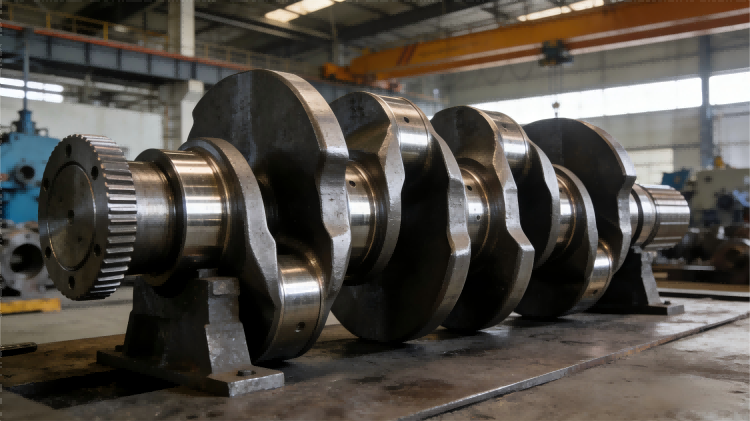
The main engine of a ship (diesel engine, gas turbine) is the "heart" of navigation, and the crankshaft and connecting rod, as the core moving parts of the main engine, need to withstand huge explosive forces and periodic loads. This type of forging is mostly made of high-strength alloy structural steel through die forging. It features dense internal grains and uniform mechanical properties, which can withstand long-term and frequent impacts and wear, ensuring the continuous and stable power output of the main engine. The weight of the crankshaft forgings of a 10,000-ton vessel can reach tens of tons, and their forging accuracy directly determines the power efficiency and service life of the main engine.
Key components of the propulsion system: propeller shaft and tail shaft forgings
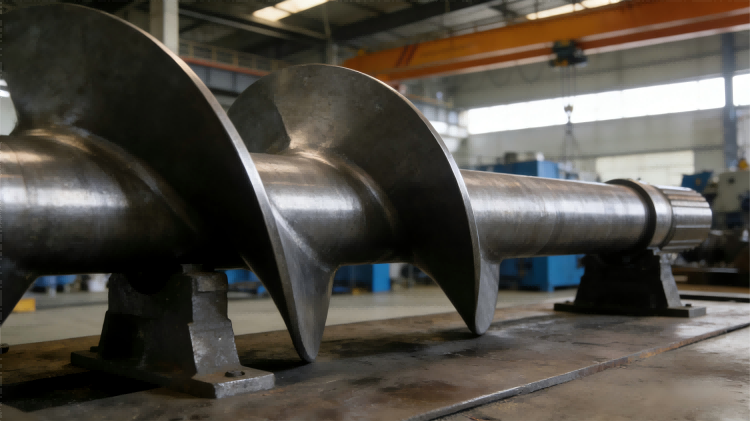
The propeller shaft (tail shaft) is the "power transmission shaft" that connects the main engine and the propeller. It needs to withstand torque, water pressure and seawater corrosion for a long time underwater. The ship propeller shaft forgings are formed by forging stainless steel or corrosion-resistant alloys. After precise processing and anti-corrosion treatment, they not only have extremely high torsional strength but also can resist seawater erosion, avoiding power interruption caused by rust and fracture of the shaft body. The tail axle, made of high-quality forgings, can achieve continuous navigation for tens of thousands of nautical miles without failure.
Hull structure support: anchor chains, hooks, deck mechanical forgings
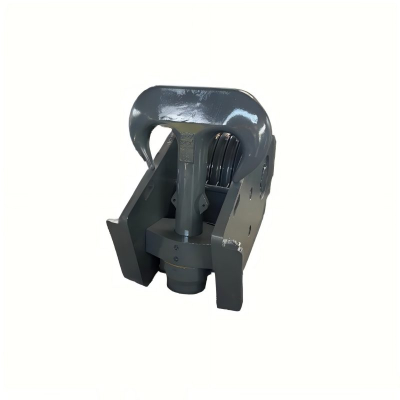
The anchor chains, cargo lifting hooks, deck cranes and other equipment of ships are directly related to the safety of berthing and the efficiency of cargo handling. These components are all typical forged products and need to withstand heavy loads, impacts and outdoor corrosive environments. For instance, anchor chain forgings eliminate internal defects through multiple forging processes, and their tensile strength can reach over 1000MPa, enabling them to firmly secure ships in strong winds and huge waves. The forgings of the lifting hook are heat-treated and strengthened to ensure that no plastic deformation or fracture occurs when lifting tens of tons of goods.
Emergency support core: Rudder rods, thrust shaft forgings
The rudder is the "steering center" of a ship, and the thrust shaft is responsible for transmitting the power of the main engine to the propeller. Both need to maintain structural stability under complex force conditions. The rudder rod forgings are made through an integral forging process, avoiding the strength risks brought by welding and enabling precise transmission of steering torque. Thrust shaft forgings enhance fatigue resistance by optimizing the flow direction of metal fibers, ensuring the reliability of the ship's handling during emergency steering and braking.
Ii. Forging Process: The "Core Code" for Marine Forgings to Adapt to Deep-sea Working Conditions
The harshness of the Marine environment (high corrosion, high pressure, and strong impact) determines that ordinary casting or stamping processes cannot be used for ship components. Forgings, with their unique technological advantages, have become the first choice for shipbuilding.
Double the strength and withstand extreme loads
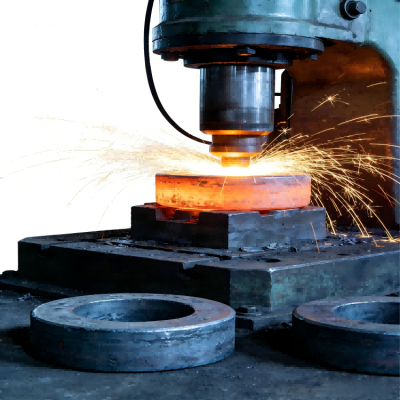
Forging process involves pressing metal billets at high temperature and high pressure to refine the internal grains and denser the structure, completely eliminating common defects such as pores, sand holes and porosity in castings. The tensile strength and yield strength of ship forgings are 30% to 50% higher than those of similar castings. Their impact resistance far exceeds that of ordinary components. They can easily cope with extreme working conditions such as huge waves and heavy equipment loads encountered during ship navigation, avoiding sudden component failure.
Corrosion-resistant and wear-resistant, extending service life
Ship forgings mostly use high-quality alloy materials (such as 316 stainless steel and 42CrMo alloy steel), and are combined with heat treatment processes after forging (such as carburizing and nitriding), the surface hardness can be increased to above HRC55, and the wear resistance and corrosion resistance are significantly enhanced. In corrosive environments such as seawater and salt spray, the service life of high-quality ship forgings can reach 2 to 3 times that of ordinary components, significantly reducing the maintenance frequency and replacement costs of ships. They are particularly suitable for ships that undertake long-term ocean voyages.
The size is precise and meets the assembly requirements
The assembly accuracy requirements for ship components are extremely high. Even the slightest deviation may lead to equipment operation jamming and seal failure. Precision forging technology can achieve "near-net forming" of ship forgings, with dimensional tolerances controlled within ±0.05mm. Only a small amount of fine processing is required subsequently to meet the assembly requirements. For instance, the coaxiality error of the propeller shaft forgings can be controlled at the micrometer level, ensuring a perfect fit with the bearings and propellers, and reducing vibration and energy consumption during operation.
The structure is complete, enhancing safety redundancy
Key ship components (such as crankshafts and rudders) adopt an integral forging process, avoiding the weak links of welded structures and ensuring the structural integrity of the components under complex force conditions. Meanwhile, the continuous metal fiber flow direction formed during the forging process is consistent with the force direction of the components, further enhancing the fatigue resistance, providing additional safety redundancy for ship navigation, and reducing the risk of failure.
Iii. Guide to Selecting Ship Forgings: 3 Core Points to Avoid Procurement Pitfalls
For shipbuilding enterprises and ship repair shops, choosing high-quality forgings is the key to ensuring the safe operation of ships. When purchasing, the following three points should be given special attention:
Verify the material and process qualifications
Give priority to suppliers that provide material certificates (such as material test reports), forging process reports, and non-destructive testing reports (ultrasonic flaw detection, magnetic particle flaw detection) to ensure that the forgings have no internal defects. At the same time, it is confirmed that the forgings are made by die forging (rather than free forging). The dimensional accuracy and mechanical properties of die forgings are more stable and better meet the requirements of the core components of ships.
Select the specification according to the working conditions
Select the corresponding forgings based on the type of vessel (cargo ship, passenger ship, fishing vessel, special vessel) and the application scenarios (near-sea, ocean-going, polar regions) : For ocean-going vessels, the crankshaft and stern shaft forgings should be made of high-strength corrosion-resistant alloys. The forgings of polar navigation vessels need to have low-temperature resistance. For anchor chain and hook forgings of offshore operation vessels, emphasis can be placed on heavy-load impact performance.
Pay attention to surface treatment and compatibility
The surface treatment of ship forgings directly affects their corrosion resistance. It is necessary to confirm that the products have undergone anti-corrosion coating, galvanization, chromium plating and other treatments. At the same time, check the dimensional tolerances of the forgings and the parameters of the installation interfaces to ensure precise compatibility with the original equipment of the ship, and avoid problems such as vibration and seal failure caused by excessive assembly clearance.
Summary
Forgings, as the core and fundamental components of shipbuilding, are the "cornerstone" that ensures the power output, structural stability and navigation safety of ships. From the main engine crankshaft to the propeller shaft, from the anchor chain hook to the rudder rod thrust shaft, the quality of each key forging directly affects the navigation efficiency of the ship and the safety of personnel. Under the trend of intelligent and large-scale development of ships, the importance of high-quality forgings is becoming increasingly prominent.
If you need to know more about customized forging solutions for ship forgings, forging adaptation cases for different types of ships, or obtain a comparison table of forging inspection standards, please feel free to contact us at any time! We will provide you with high-quality forging products that comply with international ship standards (such as ABS, DNV, CCS) and professional technical support.
- Previous : Selection Guide for Core Components of Coal Mine Machinery: How Do Forgings, Pin Rails, Cylinder Bottoms, and Dumbbell Pins Ensure Efficient Underground Operations
- Next : Wind power forgings: The "hardcore support" for stable power generation of wind turbines, all core components rely on it!