Upgrade Slewing Reducer Service Life: Forged Forgings Replace Castings for Higher Fatigue Resistance of Support Shafts
The slewing reducer serves as the core rotary transmission component for construction machinery and wind power equipment. It is widely applied in excavators, truck-mounted cranes, tower cranes, rotary drilling rigs, as well as wind turbine yaw and pitch mechanisms, undertaking 360° equipment rotation, torque amplification and stable power transmission. The load capacity, fatigue resistance and operational stability of the entire reducer depend entirely on the material quality and processing technology of its core stressed components — support shafts and various transmission forged parts.
Slewing mechanisms consistently operate under extreme working conditions including low-frequency heavy loads, continuous torsion, alternating stress and frequent start-stop cycles. Conventional shaft parts manufactured by casting and rolling processes feature loose internal structure, insufficient strength and poor fatigue resistance. Long-term operation easily leads to support shaft bending, keyway wear, shaft head fracture, gear tooth breakage, reducer jamming and abnormal noise, which greatly increases equipment downtime and operation and maintenance costs.
At present, high-end wind power yaw and pitch reducers and heavy-duty construction machinery slewing reducers all adopt forging technology to produce support shafts and transmission forged parts. With dense metallographic structure, continuous metal flow lines and superior toughness, forged parts fundamentally eliminate the vulnerability of ordinary components and greatly extend the service life of slewing reducers. This article elaborates on the process advantages and industrial application value of forged parts and forged support shafts for slewing reducers.
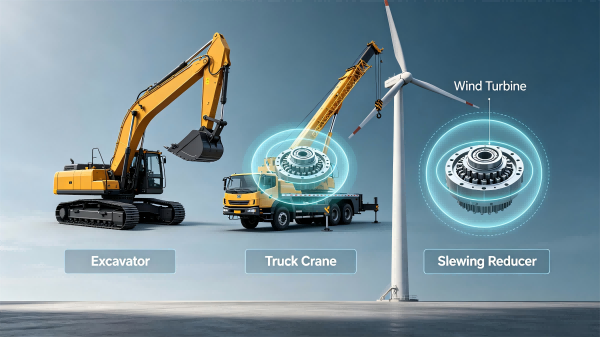
1. Working Condition Characteristics and Component Pain Points of Slewing Reducers
Whether used in wind power rotary mechanisms or construction machinery rotary systems, core slewing reducer components operate under harsh stress environments, where ordinary machined parts fail to support long-term stable operation:
High alternating torque load: Instant torque surges during slewing start and stop easily cause plastic deformation in ordinary shafts, resulting in support shaft eccentricity and unbalanced transmission.
Long-term high-frequency fatigue damage: Wind turbines perform 24-hour uninterrupted yaw adjustment, and construction machinery conducts repeated slewing operations. Continuous torsional fatigue tends to produce hidden cracks in cast components.
Severe impact load: Construction machinery operations such as lifting, excavation and rotary drilling generate strong impact force. Ordinary parts have poor impact resistance and are prone to fracture failure.
Poor precision accelerates wear: Non-forged blanks feature unstable material properties and post-processing deformation, causing uneven meshing gaps, abnormal wear and excessive noise inside the reducer.
Therefore, to fundamentally reduce the failure rate of slewing reducers, traditional ordinary parts must be replaced with a complete solution of forged support shafts and forged parts.
2. Core Advantages: Forged Parts vs Ordinary Castings & Rolled Parts
2.1 Dense Forged Structure with Zero Internal Defects
Specialized forged parts and support shafts for slewing reducers are manufactured from high-quality alloy steel through multi-pass high-temperature forging. High-pressure forging crushes coarse grains and compresses inherent internal defects such as porosity, looseness, inclusions and microcracks, forming a uniform and dense metallographic structure without weak sections. Compared with ordinary cast and rolled shafts, the overall strength, toughness and impact resistance are improved by more than twice, completely avoiding sudden fracture failures under heavy-load working conditions of wind power and construction machinery equipment.
2.2 Continuous Metal Flow Lines Improve Fatigue Resistance
The forging process forms complete and continuous metal flow lines according to the axial force and torsional transmission structure of support shafts. The flow lines perfectly fit the stress trajectory without the fracture and disorder defects of castings. Facing the long-term fatigue load of all-weather wind power operation and frequent impact torsion of construction machinery, forged parts resist metal fatigue and hidden cracks effectively, maintaining stable shape and structure during long-term operation and fully meeting the long-cycle operation requirements of slewing reducers.
2.3 Stable Forged Blanks Support Precision Machining
Forged support shaft blanks feature uniform hardness, low internal stress and stable structure. After professional stress-relief heat treatment, no subsequent deformation or warpage occurs. High-precision finishing ensures accurate shaft coaxiality, keyway precision, end face flatness and assembly tolerance, enabling smooth transmission, uniform gaps and silent operation of slewing reducers while avoiding jitter and abnormal wear.
3. Processing Flow of Forged Support Shafts and Forged Parts for Slewing Reducers
3.1 Precision Forging Forming
Custom forging parameters including compression ratio, temperature and forming rhythm are formulated according to the heavy-load torsion characteristics of slewing reducers. Integral die forging is adopted for long support shafts and special-shaped transmission forged parts to ensure uniform mechanical properties and no stress concentration, maximizing the load-bearing limit and fatigue resistance of components from the source.
3.2 Professional Heat Treatment Modification
All forged support shafts and reducer forged parts undergo complete heat treatment processes including quenching and tempering and stress relief annealing. The process refines metallographic structure and balances hardness and toughness, ensuring excellent surface wear resistance and torsion resistance as well as integral structural toughness and crack resistance, adapting to the complex and extreme working conditions of wind power and construction machinery equipment.
3.3 High-Precision Finishing
Equipped with CNC turning and milling centers, precision grinders and keyway processing equipment, we conduct full-dimensional finishing on support shafts and various transmission forged parts. Strict control over dimensional tolerance, roundness, coaxiality and surface finish ensures high precision and strong interchangeability of finished products, which can directly replace original factory slewing reducer parts.
4. Product Application Scenarios
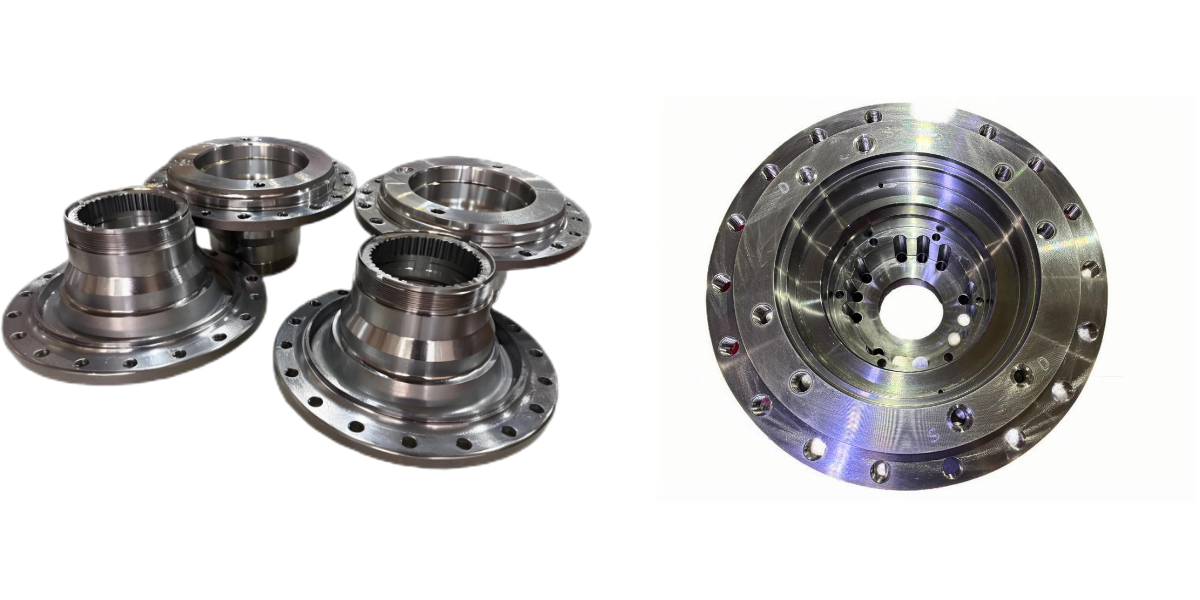
Our series of forged slewing reducer parts and forged support shafts are widely applicable to various wind power equipment and construction machinery, supporting new equipment assembly, old part replacement and equipment upgrading:
Wind Power Equipment: Forged support shafts and transmission parts for wind turbine yaw reducers and pitch reducers
Construction Machinery: Forged support shafts for slewing reducers of excavators, truck-mounted cranes, tower cranes, rotary drilling rigs and piling machines
Heavy-Duty Transmission Equipment: Forged parts for large slewing platforms, heavy-duty planetary reducers and precision rotary transmission mechanisms
We support mass production of standard models, non-standard customization based on drawings and reverse engineering of old parts.