What is the selection logic for the core components of the rotary reducer?
What is the selection logic for the core components of the rotary reducer?
I. Planet Carrier - The "Torque Hub" of the Rotating Reducer, The Forging Process Determines the Upper Limit of the Entire Machine's Lifespan
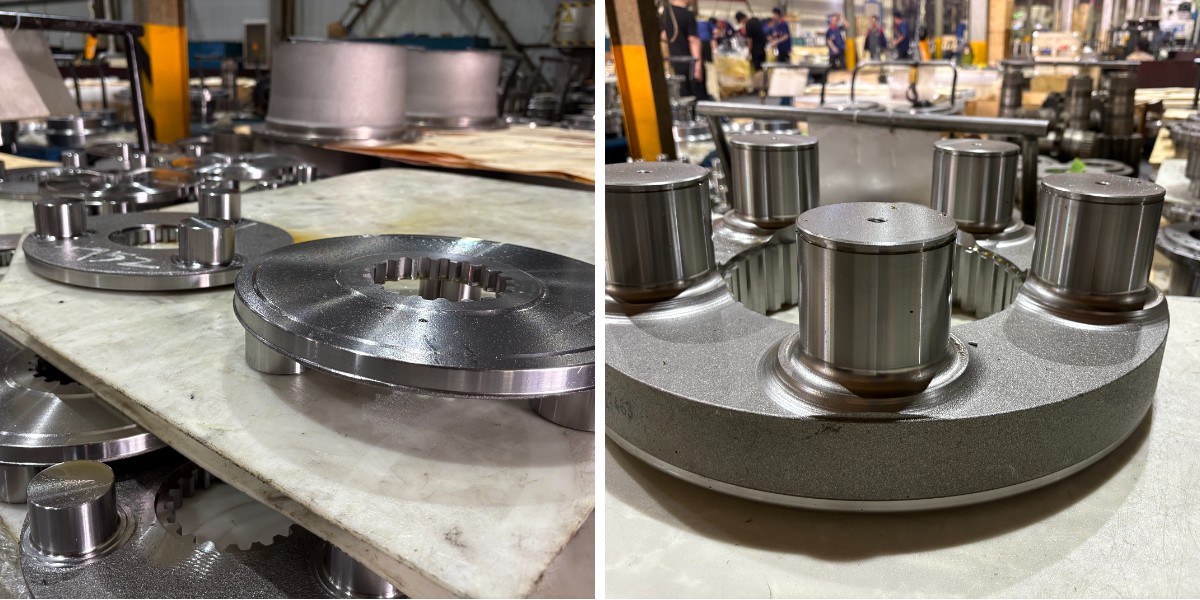
In wind turbine gearboxes and construction machinery's rotating reducers, the planet carrier is the core structural component that bears multiple sets of planet gears, evenly distributes torque, and connects the input and output shafts. Its performance directly determines the transmission stability and lifespan of the entire machine. The reliability of the planet carrier lies fundamentally in the selection and processing of the forgings - this is a key distinction from castings.
Wind power and construction machinery operating conditions feature "high impact, large torque, and long-term operation": the wind turbine planet carrier needs to withstand ±50℃ extreme temperature differences and gusty wind impacts, while construction machinery (cranes, excavators, mining equipment) must deal with frequent start-stop and heavy-load unbalanced loads. Industry data shows that 60% of the failures in rotating reducer systems are related to the quality of the planet carrier, with 80% caused by forging defects (coarse grains, inclusions, uneven heat treatment).
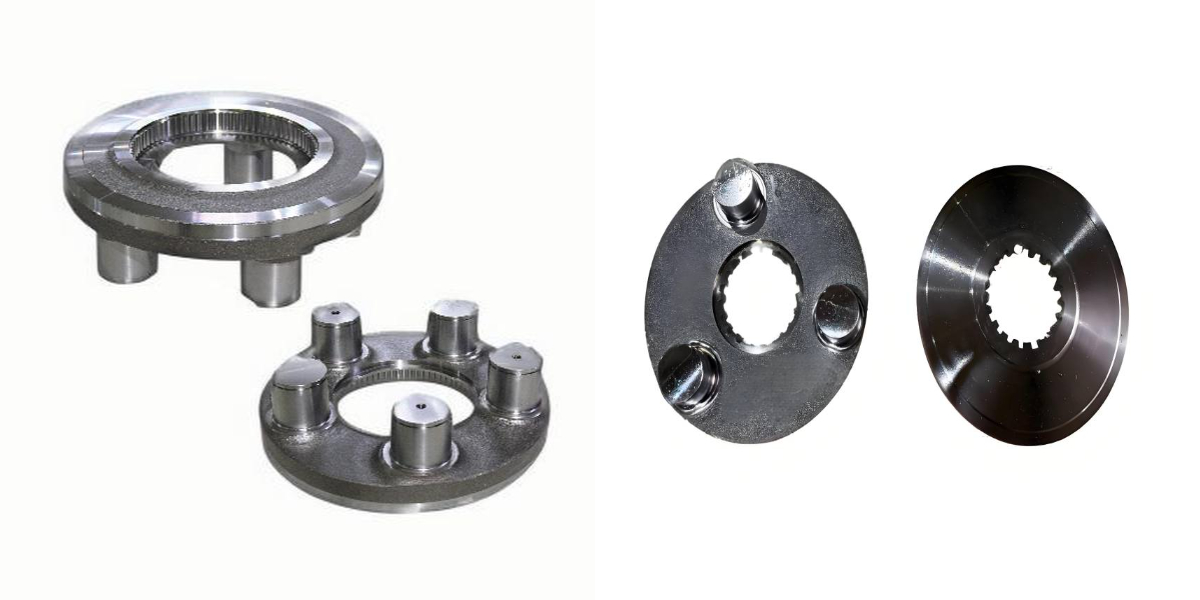
Core Standards and Process Requirements
Material Selection: Preferentially select alloy steel forgings such as 42CrMo, 34CrNiMo6, 18Cr2Ni4W, with tensile strength ≥ 830 MPa, yield strength ≥ 700 MPa, -40℃ impact energy ≥ 27 J, meeting the IEC 61400-4:2025 standards for wind power and the GB/T 10561 standards for construction machinery;
Forging Process: Forging ratio ≥ 3.0, eliminating coarse grains through electric furnace smelting + vacuum degassing to reduce P and S contents (P ≤ 0.020%, S ≤ 0.015%), reducing brittle risks from the source;
Heat Treatment: After quenching + high-temperature tempering, hardness controlled at HB229–269, bearing position induction hardening layer depth 3–5 mm, hardness 50–55 HRC, ensuring load-bearing and wear resistance balance;
Non-destructive Testing: 100% UT flaw detection (equivalent defect ≤ Φ3mm) + MT/PT surface inspection, no cracks or linear defects in key areas, which is a mandatory requirement for large-megawatt offshore wind turbines.
II. Dual Scenarios of Wind Power & Construction Machinery: Differentiated Selection and Application Points of Planet Carrier Forgings
1. Wind Power Scenario: Forging Upgrade Necessity for Large-Megawatt Wind Turbines
With the explosion of offshore wind power installations, 15MW + large-megawatt wind turbines require the planet carrier to upgrade from "usable" to "reliable". The IEC 61400-4:2025 standard implemented in 2025 clearly stipulates that for offshore wind turbines, the planet carrier must use forged steel parts and prohibit cast steel parts, with the fatigue safety factor increasing by more than 15% compared to the 2012 version.
Core Pain Points: Cast iron planet carriers are prone to crack propagation under -30℃ low temperatures and alternating loads, with crack expansion rate reaching 10^-8 m/cycle, causing the entire machine to stop;
Selection Focus: Prioritize 18CrNiMo7-6 forgings, with 30% higher fatigue resistance than ordinary alloy steel, suitable for high-salt spray environments; require suppliers to provide PPAP certification and full-process inspection reports to ensure forging density and uniformity;
Typical Applications: Wind turbine yaw drive, second/ third-stage planet carriers of the speed reducer, requiring finite element analysis of the coupling of rigidity and flexibility to verify the influence of planet carrier deformation on gear meshing.
2. Construction Machinery Scenario: Handling Heavy Load and Unbalanced Load of Rotating Reducers
Construction machinery's rotating reducers are used in cranes, tower cranes, excavators, etc., with the core requirement being resistance to impact, tolerance to unbalanced loads, and rapid response. Industry data shows that the market size of heavy machinery rotating reducers has exceeded 8.7 billion yuan in 2025, with a compound annual growth rate of 12.7%, and 68% of enterprises have suffered downtime losses due to planet carrier failures. Core pain point: If the forging ratio of the single-arm planetary gear forging is insufficient, it is prone to bending deformation under uneven loading, resulting in uneven engagement of the planetary gears and causing tooth breakage and oil leakage;
Selection focus: Prioritize symmetrical double-arm planetary gear forgings, with an improvement in load distribution uniformity by 40%; The material is selected as 42CrMo, and the tooth surface hardness after carburizing and quenching is 58–62 HRC, while the core hardness is 32–40 HRC, suitable for frequent impact conditions;
Key parameters: The rated torque should be reserved with a safety factor of 1.2–1.5, the bearing clearance should be ≤ 0.02mm, to avoid early wear caused by uneven loading.
III. Common Faults of Planetary Gear Forgings and Pit Avoidance Guide (with Detection Methods)
1. Three major high-frequency faults and their causes
Fault Type | Typical Performance | Typical Performance | Consequences |
Cracking / Fracture | Sudden abnormal noise during operation, sudden torque drop | Coarse grain in forgings, uneven heat treatment, insufficient forging ratio | Machine shutdown, maintenance cost accounting for more than 30% of equipment |
Deformation / Deflection | Increased transmission noise, abnormal gear meshing marks | Out-of-tolerance straightness of forgings, excessive installation clearance | Accelerated wear of planetary gears, 50% reduction in service life |
Surface Pitting / Spalling | Bearing position heating, metal particles in lubricating oil | Insufficient surface hardness of forgings, poor lubrication | Reduced transmission efficiency, chain failure |
2. Three major inspections must be conducted during procurement and acceptance
Appearance and dimensions: The flatness of the end face of the planetary gear housing should be ≤ 0.03mm/m, the coaxiality of the bearing holes should be ≤ 0.02mm, and there should be no air holes, folds, or cracks on the surface;
Physical and chemical testing: Conduct tensile tests according to ISO 6892-1, and conduct low-temperature impact tests according to EN 10045-1 to ensure that the mechanical properties meet the standards;
Non-destructive testing: UT testing for internal defects (acceptance standard: equivalent ≤ Φ3mm), MT testing for surface cracks (zero tolerance), and PT testing for key transition rounded corners.
3. Four principles for avoiding pitfalls in procurement
Refuse "cast-to-mold" low-price products: The tensile strength of the cast planetary gear housing is 30% lower than that of the forged one, and it is prone to brittle fracture in low-temperature environments;
Clarify process parameters: Require a forging ratio of ≥ 3.0, and the uniformity of the heat treatment furnace temperature should be ±10℃, to avoid uneven organization;
Recognize qualification certifications: Prioritize suppliers with ISO 9001 and IATF 16949 certifications, and those with cases in the wind power / construction machinery industry;
Sign a quality agreement: Clearly define the responsibility for forging defects, and promise MTBF (Mean Time Between Failures) ≥ 40,000 hours.
IV. Industry trends in 2026: Technological upgrading and market opportunities of planetary gear forging
1. Direction of technological upgrading
Material upgrading: Titanium alloy forging parts are gradually applied in the lightweight scenarios of onshore wind power, reducing the weight by 25% compared to alloy steel, and increasing the strength by 18%;
Process innovation: Near-net-shape forging technology reduces processing allowances, lowers costs by 15%, and improves the forging part density;
Intelligent testing: AI ultrasonic testing replaces manual work, with defect recognition accuracy improved to ±0.5mm, and shortens the acceptance cycle.
2. Market size and demand forecast
According to industry reports, the market size of planetary gear forging parts for wind power and construction machinery exceeded 12 billion yuan in 2025, with a compound annual growth rate of 12%. Specifically:
Wind power sector: The new installation of offshore wind power drives an increase in demand for forging parts by 18%, and the unit price of 15MW + type forging parts increases by 35%;
Construction machinery sector: The upgrade of mining machinery and port cranes drives the growth of demand for large-torque planetary gears, and the market size will exceed 5 billion yuan in 2026.
3. Core logic for selection
Whether in wind power or construction machinery, the selection of planetary gear forging parts should follow the principles of "process priority, adaptation to the scene, and full-cycle reliability":
Wind power scenario: Prioritize high-end forging parts, sacrificing cost for 20 years of stable operation;
Construction machinery scenario: Balance cost and performance, choose 42CrMo forging parts with good cost-performance;
General requirements: Must match the lubrication system of the rotary reducer, with the lubricating oil pour point ≤ -40℃ and TOST life > 5,000 hours, to extend the service life of the planetary gear.
V. Summary: Selecting the right planetary gear forging parts is a key step for cost reduction and efficiency improvement
The planetary gear as the "torque center" of the rotary reducer in wind power and construction machinery is a core factor determining the lifespan, reliability, and operation and maintenance costs of the entire machine. In 2026, the industry is in a critical period of large-megawatt upgrades and equipment large-scaleization, and the downtime losses and maintenance costs caused by inferior planetary gears are much higher than the procurement price difference of high-quality forging parts.
Selecting suppliers with standardized forging process, complete testing system, and rich industry experience can not only avoid early failures but also achieve the goal of "cost reduction, efficiency improvement, and long-term stability" through precise selection and adaptation to different working conditions. Whether it is the 20-year lifespan commitment of wind power projects or the efficient operation requirements of construction machinery, high-quality planetary gear forging parts are indispensable core guarantees.