EV Hub Manufacturing Process Revealed: Forging vs. Casting, Which Is More Suitable for the High Torque Requirements of New Energy Vehicles?
EV Hub Manufacturing Process Revealed: Forging vs. Casting, Which Is More Suitable for the High Torque Requirements of New Energy Vehicles?
Among the core components of EVs, the hub directly bears the weight of the vehicle body and transmits driving force. Its performance directly affects the vehicle's range, handling and safety. Especially in the face of the characteristic of instantaneous high torque output of new energy vehicles, the shortcomings of traditional cast wheel hubs have gradually been exposed, while EV hubs made by forging process are becoming the mainstream in the industry with their outstanding performance. This article will deeply disassemble the two core manufacturing processes of forging and casting, and compare and analyze them from the dimensions of material, structure, and performance, to tell you which process of hub is more suitable for the high torque requirements of new energy vehicles.
I. Understand the core: Why is the EV Hub so strict in terms of process requirements?
The core differences between new energy vehicles and traditional fuel vehicles determine that EV hubs must meet higher performance standards:
High-torque impact: When the motor starts, it can instantly output the maximum torque. The hub needs to withstand an instantaneous load several times that of a fuel vehicle to prevent deformation or breakage.
Lightweight demand: As a key part of the unsprung mass, for every 1kg reduction of the wheel hub, the driving range can be increased by approximately 5-8km, which has extremely high requirements for the material utilization rate of the process.
Safety redundancy: The increased weight of the battery in new energy vehicles leads to an increase in the vehicle's inertia. The impact resistance and fatigue resistance of the hub are directly related to driving safety.
Heat dissipation requirements: The heat from the motor drive system is easily conducted to the hub. It is necessary to ensure that the hub has good heat dissipation performance through process to avoid high temperatures affecting performance.
The two processes of casting and forging fundamentally determine the core indicators of the hub such as its molecular structure, strength and weight, and thereby affect its adaptability to high torque demands.
Ii. Craftsmanship Showdown: Forging vs. Casting, the Core Differences in EV Hub Manufacturing
1. Casting process: Traditional mass production choice, showing a shortcoming in high-torque scenarios
Casting is a process in which molten metal is poured into a mold, cooled and then formed. It was once widely used in the manufacturing of traditional fuel vehicle hubs.
Process features: The process is relatively simple, capable of mass-producing complex-shaped hubs, and the manufacturing cost is relatively low.
Structural defects: When molten metal cools, internal defects such as pores, sand holes, and shrinkage cavities are prone to occur. The molecular structure is loose and the density is relatively low.
Performance: The tensile strength is usually between 300 and 500MPa, with poor impact resistance. In the face of the instantaneous high torque of new energy vehicles, it is prone to cracking, deformation, and even poses safety hazards.
Limitations of lightweighting: To ensure strength, the wall thickness of the cast hub needs to be increased, resulting in a relatively large weight, which is not conducive to the improvement of the range of new energy vehicles.
2. Forging process: High-performance preferred, precisely matching high torque requirements
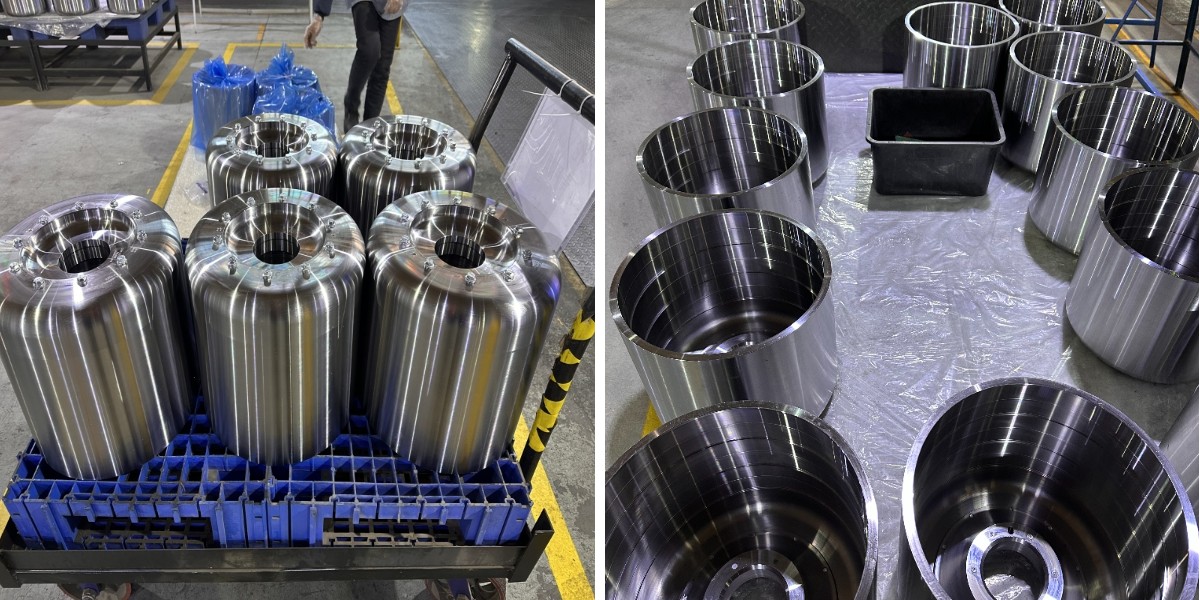
Forging is a process in which metal billets are extruded and forged into shape through molds under high temperature and high pressure. It is the core manufacturing method of high-end EV hubs.
Process features: After forging, the molecular structure of the metal billet is fully compacted, the grains are refined and closely arranged, and there are no casting defects.
Structural advantages: Integrally forged, no welding seams, strong structural integrity, and a density 15%-20% higher than that of cast hubs.
Performance: The tensile strength can reach 800-1200 mpa, more than twice that of cast hubs. It has excellent impact resistance and fatigue resistance, and can easily withstand the instantaneous high-torque impact of new energy vehicles.
Lightweight breakthrough: The forging process can significantly reduce the wall thickness of the hub while ensuring high strength. Its weight is 20%-30% lighter than that of the cast hub of the same specification, significantly reducing the unsprung mass and enhancing the battery life and handling performance.
| Comparison Dimension | Casting Process EV Hub | Forging Process EV Hub |
| Molecular Structure | Loose, prone to pores and sand inclusions | Dense, refined and tightly arranged grains |
| Tensile Strength | 300-500MPa | 800-1200MPa |
| Weight Performance | Relatively heavy, requiring increased wall thickness | Lightweight, wall thickness can be reduced by 20%-30% |
| Torque Resistance | Weak, prone to deformation under high torque | Extremely strong, suitable for instantaneous high torque output |
| Safety Margin | Low, prone to cracks during long-term use | High, excellent impact and fatigue resistance |
| Manufacturing Cost | Low, suitable for mass production | High, oriented towards high-end performance |
Iii. Practical Verification: Why has Forged EV Hub Become a Standard Feature of High-Torque Vehicles?
1. High-torque scene adaptation: Fearless of instantaneous impacts
When a new energy vehicle accelerates, the high torque instantaneously output by the motor is directly transmitted to the hub. Forged EV Hubs, with their dense molecular structure and high tensile strength, can quickly disperse torque loads and prevent local stress concentration. For instance, after a certain new energy SUV is equipped with a forged hub, during the 0-100km/h acceleration (with a peak torque of 350N · m) scenario, the deformation of the hub is only one-third of that of a cast hub, and there is no risk of cracking over long-term use.
2. Lightweight + battery life win-win: Balancing performance and efficiency
Forging the lightweight advantage of EV hubs directly translates into an increase in the range of new energy vehicles. Data shows that a forged hub is 8 to 12 kilograms lighter than a cast one, which can increase the range of new energy vehicles by 40 to 96 kilometers, while reducing the load on the motor and lowering energy consumption. For pure electric vehicle models that pursue long range, forging technology is the key path to achieving "high performance + long range".
3. Adaptability to complex working conditions: Safety performance is maximized
In complex scenarios such as bumpy roads and emergency braking, the anti-impact performance of forged EV hubs is particularly outstanding. After testing, forged hubs can withstand an impact load 2.5 times their own weight, while cast hubs are prone to edge cracking under the same load. This feature makes forged EV Hubs the preferred choice for models with extremely high safety requirements, such as new energy commercial vehicles and high-performance sports cars.
Iv. Industry Trends: Forging technology becomes the mainstream of EV Hub development
As new energy vehicles develop towards high power, long range and intelligence, the market's performance requirements for hubs are continuously upgrading, and the penetration rate of forging processes is rapidly increasing
Automakers' layout: Leading automakers such as Tesla, BYD, and NIO have made forged hubs a standard feature for mid-to-high-end models, and even launched customized forged wheel options.
Technological upgrade: The application of technologies such as precision forging and near-net-shape forming has further reduced the manufacturing cost of forged EV hubs, promoting their popularization in mid-range models.
Material innovation: The combination of aluminum alloy, carbon fiber composite materials, etc. with forging technology has enabled EV Hub to achieve greater breakthroughs in strength and lightweight.
For consumers, choosing new energy vehicles equipped with forged hubs means more reliable high-torque output, longer driving range and safer driving guarantees. For automakers, adopting forging processes is a core means to enhance the competitiveness of their products.
V. Purchasing Guide: How to Identify Forged EV Hubs and Avoid Selection Pitfalls?
1. Check the process marking: Confirm the forging properties
Ask the merchant to provide a forging process report, clearly marking information such as "integral forging" and "die forging forming", to avoid purchasing fake forging hubs with "casting + welding".
Observe the appearance of the hub: The surface of the forged hub has no casting pores or burrs, and the lines are smooth. The forging marks on the back of the hub are clearly visible.
2. Check core parameters: Focus on performance indicators
Material: It is preferred to choose high-strength aluminum alloy forged hubs such as 6061-T6 and 7075-T6, which balance strength and lightweight.
Strength data: Tensile strength ≥800MPa, yield strength ≥500MPa, ensuring compliance with high torque requirements;
Weight: Under the same size, forged hubs are over 20% lighter than cast hubs, which can be verified by weighing comparison.
3. Recognize brand qualifications: Choose a regular manufacturer
Give priority to choosing manufacturers that focus on automotive forging parts. Their processes are more mature and the quality is more guaranteed.
Verify product certification: Ensure that the hub has passed quality system certifications such as ISO9001 in the automotive industry and complies with relevant national standards.
Summary
The high torque characteristics of new energy vehicles pose unprecedented challenges to the performance of EV hubs. Due to structural defects, insufficient strength and other shortcomings, the casting process has been unable to meet the demands of high-end new energy vehicles. The forging process, with its core advantages such as dense molecular structure, ultra-high strength, and lightweight, has become the optimal solution for meeting high-torque demands.
Whether it is the technological upgrade of car manufacturers or the purchasing decisions of consumers, forging EV hubs has become a key choice for enhancing the performance and safety of new energy vehicles. With the continuous maturation and cost optimization of forging technology, more new energy vehicle models will be equipped with forging Hubs in the future, driving the industry towards higher performance, greater efficiency and greater safety.