Custom Gears and Splines | Master Gears & More | Gear Hobbing
Custom Gears and Splines | Master Gears & More | Gear Hobbing
In the field of mechanical transmission, Custom Gears and Splines have become core components due to their precise fit, and Gear Hobbing, as an efficient gear processing technology, is the key to ensuring transmission accuracy. Among them, the dual output gearbox and the series of dual output type components Such as output gear shaft, gearbox output shaft, dual output shaft gearbox, due to its ability to achieve "one input and two outputs" power distribution, is widely used in multi-actuator equipment. Combined with gear hobbing technology and customized design, it can fully meet complex transmission requirements.
I. Customized Gears and splines: The precision foundation of dual-output transmission systems
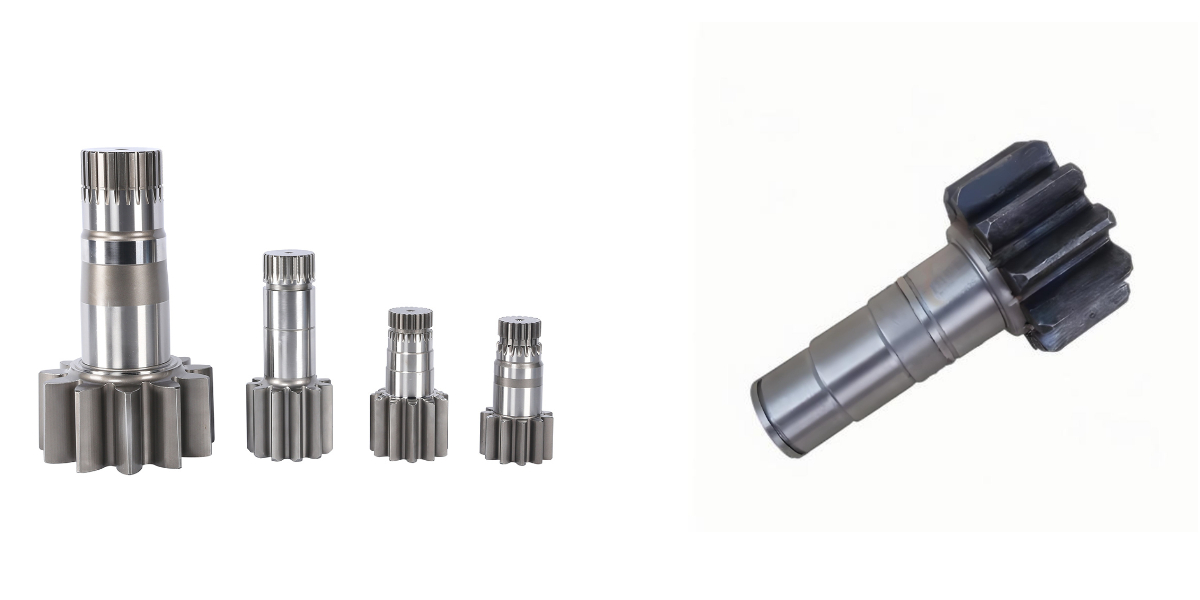
The core value of custom gears and splines lies in "precise matching", which is precisely the prerequisite for the stable operation of the dual output gearbox. Through gear hobbing, custom gears that fit the dual output shaft gearbox can be precisely machined - whether it is the tooth profile accuracy of the output gear shaft or the spline fit of the gearbox output shaft. All can achieve micron-level control through gear hobbing technology.
For example, in gearbox with two output shafts, the input power needs to be evenly distributed to the two output gear shafts through a custom gear set. At this time, the module and tooth profile curve of the gears need to be fully adapted to the dual output structure, and the efficiency and high precision of hobbing processing, It can ensure that there is no jamming or power loss when multiple sets of gears mesh synchronously. Meanwhile, custom splines can enhance the connection strength between the gearbox output shaft and the actuator, prevent the shafting of the dual output gearbox from loosening under high loads, and provide a reliable guarantee for the dual output drive.
Ii. Gear Hobbing: The core processing technology for double-output gear components
Hobbing, as the mainstream process of gear processing, plays a decisive role in the performance of dual output gearboxes and related components. The principle is to process the complete tooth profile at one time through the forming motion of the hob and the workpiece. It is particularly suitable for mass production of output gear shaft and gearbox output shaft. It can not only ensure the consistency of the tooth profile of multiple shafts, but also improve the processing efficiency.
In the production of dual output shaft gearbox, the hobbing process needs to adjust the process parameters for different output requirements: If gearbox with two output shafts needs to achieve variable speed output, Gear sets with different numbers of teeth should be processed by hobbing and combined with Planetary gear sets to form a composite transmission structure; If high torque output is required, the hobbing depth and heat treatment process need to be optimized to enhance the load-bearing capacity of the output gear shaft. In addition, gear hobbing processing can precisely control the coaxiality of the gearbox output shaft, avoid eccentric load vibration during the operation of the dual output gearbox, and extend the service life of the equipment.
Iii. Application Scenarios and Adaptation Solutions for Dual-Output Components
Components such as dual output gearbox and output gear shaft, gearbox output shaft, etc., are widely used in construction machinery, automation equipment, new energy fields, etc. because they can drive two actuators simultaneously.
In construction machinery, planetary gearboxes are often combined with dual output shaft gearboxes to distribute power to traveling mechanisms and operating devices through gearbox with two output shafts At this time, the output gear shaft needs to withstand large torque impacts and requires hobbing processing and strengthening treatment to ensure durability. In the automated production line, a one input two output gearbox combined with custom gears can synchronously drive the conveyor belt and the sorting mechanism through two gearbox output shafts. The high precision of gear hobbing processing ensures the synchronization of the two outputs and improves production efficiency.
In new energy equipment, such as photovoltaic tracking systems, the twin output shaft gearbox drives two sets of tracking brackets through the output gear shaft, and the Shaft Output accuracy depends on the tooth profile accuracy of gear hobbing processing. Custom splines enhance the connection stability between the shaft and the bracket. In machine tool equipment, the dual output gearbox can simultaneously drive the Spindle and feed mechanism through Spindle Output. The high-speed adaptability of the gearbox output shaft requires the hobbing process to achieve the dual guarantee of tooth surface smoothness and dynamic balance accuracy.
Iv. Customized Design and Optimization Strategies for Dual-Output Drive Systems
To meet the special requirements of different scenarios, the customized design of dual output gearbox and output gear shaft needs to be comprehensively optimized in combination with hobbing technology and transmission principles.
In terms of structural design, if a compact layout is required, an integrated design of Planetary Gear Set and dual output shaft gearbox can be adopted. A miniaturized output gear shaft can be processed by hobbing to reduce the space occupied by the equipment. If multi-gear output is required, a shift gear set can be added in gearbox with two output shafts. During hobbing, it is necessary to ensure the meshing accuracy of gears of different gears to avoid shift jamming.
In terms of performance optimization, for high-speed scenarios, the cumulative pitch error of the gearbox output shaft needs to be controlled through gear hobbing processing to reduce operating noise. For high-load scenarios, high-strength alloy materials should be selected to fabricate the output gear shaft. After hobbing, carburizing and quenching treatment should be carried out to enhance the hardness of the tooth surface. In addition, the tooth profile design of the custom spline needs to fit closely with the shafting of the dual output gearbox. The uniformity of the spline teeth is ensured through the hobbing process to avoid stress concentration during power transmission.
V. Industry Development Trends of Gear Hobbing Processing and Dual Output Components
With the upgrading of industrial automation and the new energy industry, the demand for dual output gearbox and output gear shaft is increasing day by day, and the hobbing processing technology is also constantly innovating. On the one hand, the application of the five-axis linkage gear hobbing machine has improved the machining accuracy of the gearbox output shaft, which can meet the high-precision transmission requirements of one input two output gearbox. On the other hand, the digital design of customized gears and splines can achieve seamless adaptation between dual output shaft gearbox and planetary gearbox, shortening the R&D cycle.
In the future, gear hobbing will develop towards high speed, high precision and green, further enhancing the performance of gearbox with two output shafts; The dual output gearbox will pay more attention to lightweight and integration. Through the optimized design of custom gears and splines, it can adapt to more high-end equipment and provide core support for the efficient operation of mechanical transmission systems.
In conclusion, custom gears and splines, hobbing processing and dual output gearbox series components complement each other. The deep integration of the three can not only meet the complex transmission requirements, but also promote the continuous development of the mechanical industry towards high precision and high efficiency.